
Solar Drone Survey & Thermal Inspection | LiDAR, Pile Alignment & EPC Monitoring
Aeroyantra delivers survey-grade solar drone mapping and thermal inspection for solar EPC projects - from pre-construction terrain analysis through pile alignment verification, construction progress tracking, and operational panel inspection.
Solar Drone Survey & Thermal Inspection | LiDAR, Pile Alignment & EPC Monitoring
Aeroyantra delivers survey-grade solar drone mapping and thermal inspection for solar EPC projects - from pre-construction terrain analysis through pile alignment verification, construction progress tracking, and operational panel inspection.
Table Of Content
- Solar Drone Survey, LiDAR & Thermal Inspection for EPC, Construction and O&M
- Solar Projects Lose Schedule and Margin at Predictable Points. All of Them Are Preventable.
- Survey-Grade Drone, LiDAR, and Thermal Data Across Every Phase of the Solar Project Lifecycle
- Start With an Accurate Solar Site Baseline - Not a Satellite Image and an Assumption
- LiDAR for Solar Sites - Terrain Precision Where Photogrammetry Has Limits
- Verify Every Solar Pile Position Before Mounting Structures Go Up
- Weekly Solar Construction Progress Data Across the Full Array - Not Just the Area the Manager Walked
- Find Every Hotspot, Bypass Diode Failure, and Underperforming String - Before They Compound
- Rooftop Solar - Accurate Roof Models and Safe Panel Inspection Without Climbing
- Keep Your Solar Asset Performing at Design Output - Across Its Full 25-Year Life
- Complete Deliverables by Project Phase
- Who Uses Aeroyantra for Solar Projects
- Frequently Asked Questions
- Ready to Catch Solar Project Problems at the Phase Where Fixing Them Is Still Affordable?
Solar Drone Survey, LiDAR & Thermal Inspection for EPC, Construction and O&M
A misaligned pile foundation discovered after module mounting begins is not a survey problem - it is a rework event that costs weeks of schedule and significant correction costs. A thermal hotspot on a string of panels that goes undetected through the first operational season is not an inspection gap - it is compounding revenue loss on an asset that was built to perform for 25 years.
Aeroyantra is a solar drone survey, LiDAR, and thermal inspection platform built for EPC construction, commissioning, and long-term O&M of solar assets. Aeroyantra delivers survey-grade drone mapping and thermal inspection for solar EPC projects - from pre-construction terrain analysis through pile alignment verification, construction progress tracking, and operational panel inspection - giving your teams the aerial data to catch problems at the phase where fixing them is still affordable.
Solar Projects Lose Schedule and Margin at Predictable Points. All of Them Are Preventable.
Solar EPC projects fail their timelines at consistent, recurring points - and almost all of them trace back to a data gap between what the site actually looks like and what the design assumed it would look like.
The pattern plays out across utility-scale and rooftop projects alike:
-
Pre-construction terrain data is inaccurate - Topographic surveys based on satellite imagery or infrequent ground surveys produce terrain models that do not reflect actual ground conditions. The result is a grading design that requires significant field adjustment, drainage that does not perform as designed, and earthwork quantities that bear no resemblance to the budget
-
Pile misalignment is discovered after mounting begins - Foundation piles driven to inaccurate positions create mounting structure conflicts that require either rework or field-engineered workarounds - both of which cost time and money that was not in the programme
-
Module installation sequencing is managed subjectively - Without consistent aerial progress data, construction managers cannot accurately assess which zones are ready for the next installation phase and which are behind
-
Panel defects accumulate through the first operational year - Manufacturing defects, installation damage, and early-onset degradation that are detectable in thermal inspection during commissioning go undetected until they appear in generation data - months after the opportunity for warranty recovery has passed
-
Vegetation and soiling issues are not detected until generation loss is measurable - Shading from vegetation growth and soiling patterns on panel surfaces affect generation performance but are not visible from ground level across large arrays
-
O&M inspection is manual and infrequent - Walking inspection teams covering utility-scale arrays of 50 MW or more produce incomplete, inconsistent data at enormous cost in time and personnel
Survey-Grade Drone, LiDAR, and Thermal Data Across Every Phase of the Solar Project Lifecycle
Aeroyantra delivers drone mapping, LiDAR, and thermal inspection workflows for solar projects - from pre-construction site survey through construction monitoring and operational panel inspection.
With RTK, PPK, and GCP-supported workflows, Aeroyantra achieves 2-3 cm horizontal accuracy and vertical precision suitable for terrain analysis, pile alignment verification, and as-built documentation across utility-scale and rooftop solar projects.
What that means across the project lifecycle:
-
Pre-construction - Accurate terrain baseline, drainage analysis, and earthwork estimation before design is committed
-
Foundation phase - Pile position and alignment verification before mounting structures are erected
-
Installation phase - Weekly progress tracking showing module installation status across the full site
-
Commissioning - Thermal inspection identifying panel defects, hotspots, and string-level issues before handover
-
Operations - Regular thermal and visual inspection of the operating array for performance monitoring and maintenance planning
Start With an Accurate Solar Site Baseline - Not a Satellite Image and an Assumption
Solar project designs built on inaccurate terrain data produce grading surprises, drainage failures, and earthwork budgets that bear no resemblance to actual quantities. A terrain model accurate to 30-50 cm from satellite imagery is not sufficient for a solar project where panel tilt, row spacing, and cable routing all depend on precise ground levels.
This replaces satellite-based assumptions with survey-grade terrain data for solar site design and grading. Aeroyantra delivers pre-construction site surveys that give solar EPC teams an accurate, georeferenced terrain baseline before design is committed.
What Aeroyantra delivers for pre-construction solar surveys:
-
High-resolution orthomosaic - True-color aerial imagery of the full site at 1-3 cm/pixel for layout planning, land use assessment, and stakeholder review
-
Digital Terrain Model (DTM) - Bare-earth surface model at 2-3 cm vertical accuracy for panel tilt design, row spacing optimization, and cable routing
-
Slope and aspect analysis - Site-wide slope mapping and aspect analysis for optimal panel orientation assessment and shading analysis
-
Drainage basin analysis - Terrain-derived catchment mapping identifying natural drainage pathways, ponding areas, and drainage infrastructure requirements
-
Cut-and-fill balance calculation - Pre-construction earthwork optimization to minimize grading costs and achieve design grades
-
Access route assessment - Terrain analysis for construction access road routing and equipment mobilization planning
-
Shadow and shading analysis - Terrain-derived horizon analysis identifying potential shading from site topography, boundary features, and adjacent structures
-
Substation and infrastructure routing - Accurate terrain data for substation siting, transmission line routing, and underground cable corridor planning
Technical Performance:
| Parameter | Specification |
|---|---|
| Georeferencing | RTK, PPK, GCP-supported |
| Horizontal accuracy | 2-3 cm under proper survey standards |
| Vertical accuracy | 2-3 cm suitable for solar grading design |
| Coverage rate | 50-200 acres per day depending on GSD |
| Output formats | GeoTIFF, DXF, SHP, LAS - AutoCAD Civil 3D, PVsyst, Helioscope compatible |
LiDAR for Solar Sites - Terrain Precision Where Photogrammetry Has Limits
Photogrammetry delivers excellent terrain models on open, vegetation-free solar sites. But many solar project sites - particularly in agricultural zones and forested areas - carry vegetation cover that photogrammetry cannot penetrate. LiDAR captures the bare-earth ground surface beneath vegetation, producing the accurate terrain baseline that solar design requires regardless of site vegetation cover.
What Aeroyantra delivers from solar LiDAR surveys:
-
Bare-earth DTM under vegetation - Ground surface model derived by filtering vegetation from the point cloud - essential for sites with crop cover, scrub vegetation, or retained trees within the array area
-
Precise drainage modeling - High-accuracy terrain data for hydraulic drainage modeling, detention basin design, and stormwater management planning
-
Precision grading design support - Cut-and-fill calculations from accurate LiDAR DTM for grading design that minimizes earthwork cost
-
Existing structure and utility mapping - Precise 3D capture of existing structures, boundary walls, and utility infrastructure within the site boundary
-
High-voltage line clearance analysis - LiDAR capture of existing overhead transmission lines for clearance analysis and safe working distance planning
Verify Every Solar Pile Position Before Mounting Structures Go Up
Pile misalignment on a utility-scale solar project is one of the most expensive construction errors to correct - because it is typically discovered when mounting structures are being erected, by which point hundreds or thousands of piles have already been driven. Correcting misaligned piles after the fact means either accepting field-engineered workarounds that compromise the structure, or pulling and re-driving piles at full cost.
This workflow turns pile alignment verification into a measurable, auditable solar construction quality control step. Aeroyantra gives solar EPC teams the ability to verify pile positions against design after driving and before mounting structures are erected - catching misalignment at the phase where correction is still straightforward.
What Aeroyantra delivers for pile alignment verification:
-
Pile position mapping - High-resolution aerial imagery and photogrammetric 3D model capturing pile cap positions across the full array after driving
-
Design-to-actual position comparison - Measured pile positions compared against design layout, with deviation flagged by row and by pile number
-
Deviation heatmap - Color-coded visualization of pile position deviations across the array - green for within tolerance, amber for marginal, red for requiring correction before mounting
-
Row alignment verification - Measured row alignment and spacing compared against design parameters for mounting structure compatibility
-
Pile height and level verification - Pile cap elevation data for level verification before mounting structure installation
-
Section-by-section sign-off - Array sections verified and signed off progressively as piling is completed, enabling mounting to proceed in completed sections while piling continues in others
Weekly Solar Construction Progress Data Across the Full Array - Not Just the Area the Manager Walked
Progress management on a 50-100 MW solar project covering hundreds of acres is fundamentally impossible from ground level. A site manager walking the array sees a fraction of the total area and produces a subjective assessment of overall completion. Aeroyantra replaces subjective assessment with georeferenced, time-stamped aerial data that shows exactly what was installed, where, and when - across the full site, every week.
What Aeroyantra delivers for solar construction progress tracking:
-
Weekly orthomosaic updates - Current site condition captured and processed within 24-48 hours of flight, covering the full array area in a single mission
-
Installation zone mapping - Aerial identification of completed piling zones, mounting structure zones, and module installation zones across the full array
-
Percentage completion by section - Quantified installation progress by array section, replacing subjective estimates with measured data
-
Time-series progress comparisons - Repeat surveys registered to a common datum, enabling side-by-side comparison of installation progress across the project timeline
-
Programme comparison - Current installation status compared against the project programme to identify sections ahead of or behind schedule
-
Subcontractor progress verification - Independent measurement of subcontractor installation progress for payment certification
-
Stakeholder reporting - Browser-based 3D viewer sharing for remote client and investor access without software installation
-
Cable routing and trenching documentation - Aerial record of cable trench routing and backfill completion for as-built documentation
Find Every Hotspot, Bypass Diode Failure, and Underperforming String - Before They Compound
Thermal inspection is the highest-value drone application in solar operations. A panel with a hotspot, a bypass diode failure, or a soiling anomaly generates less power, degrades faster, and in some cases creates a fire risk - but it looks identical to a healthy panel from ground level. The only way to find it efficiently across a large array is from the air with a thermal camera.
This creates a panel-level, georeferenced thermal inspection record for warranty, performance, and fire-risk management. Aeroyantra supports thermal drone inspection workflows for solar projects at commissioning and throughout the operational lifecycle.
What Thermal Inspection Detects
Panel-level defects:
-
Hotspots - Localized high-temperature zones on individual cells caused by cell damage, contamination, or manufacturing defects - the most common and most damaging panel-level failure mode
-
Bypass diode failures - Failed bypass diodes produce characteristic thermal signatures across cell groups, reducing string output and accelerating panel degradation
-
Delamination and moisture ingress - Delamination and moisture infiltration produce thermal contrast patterns on the panel surface detectable in thermal imagery
-
Cell cracking - Micro-cracks from installation damage or mechanical stress produce thermal anomalies at the crack location
-
Soiling patterns - Non-uniform soiling produces thermal contrast across the panel surface, identifying panels requiring cleaning
String and array-level issues:
-
Underperforming strings - Strings with consistent thermal anomalies across multiple panels indicating wiring, connection, or combiner box issues
-
Shading analysis - Thermal imaging identifying shading patterns from vegetation, boundary walls, and inter-row shading for layout optimization
-
Inverter zone performance - Thermal comparison of panels across inverter zones identifying inverter-related performance issues
-
Vegetation and debris accumulation - Identification of vegetation growth and debris accumulation beneath and around panel arrays
The Thermal Inspection Workflow
1. Flight planning and timing Thermal solar inspections are conducted during peak irradiance hours - typically 10 AM to 2 PM - when panel operating temperature differentials are maximized and thermal anomalies are most detectable. Flight altitude and speed are optimized for the thermal sensor resolution required.
2. Simultaneous RGB and thermal capture Aeroyantra supports simultaneous RGB and thermal capture, producing a fused dataset where thermal anomalies are georeferenced against the visual panel imagery for precise panel identification.
3. Anomaly detection and classification Thermal anomalies are classified by type - hotspot, bypass diode, delamination, soiling - and by severity, enabling prioritized maintenance planning.
4. Panel-level report generation Each detected anomaly is georeferenced to the specific panel, row, and string, with GPS coordinates for field crew dispatch and panel ID for warranty tracking.
5. Trend monitoring across inspection cycles Repeat thermal inspections registered to a common dataset enable tracking of anomaly progression between cycles - identifying panels where condition is deteriorating and prioritizing replacement.
Rooftop Solar - Accurate Roof Models and Safe Panel Inspection Without Climbing
Rooftop solar installations require precise roof measurements for panel layout design, structural load assessment, and obstruction identification. Manual roof measurement is slow, inconsistent, and exposes survey teams to working-at-height risks on large commercial and industrial rooftops.
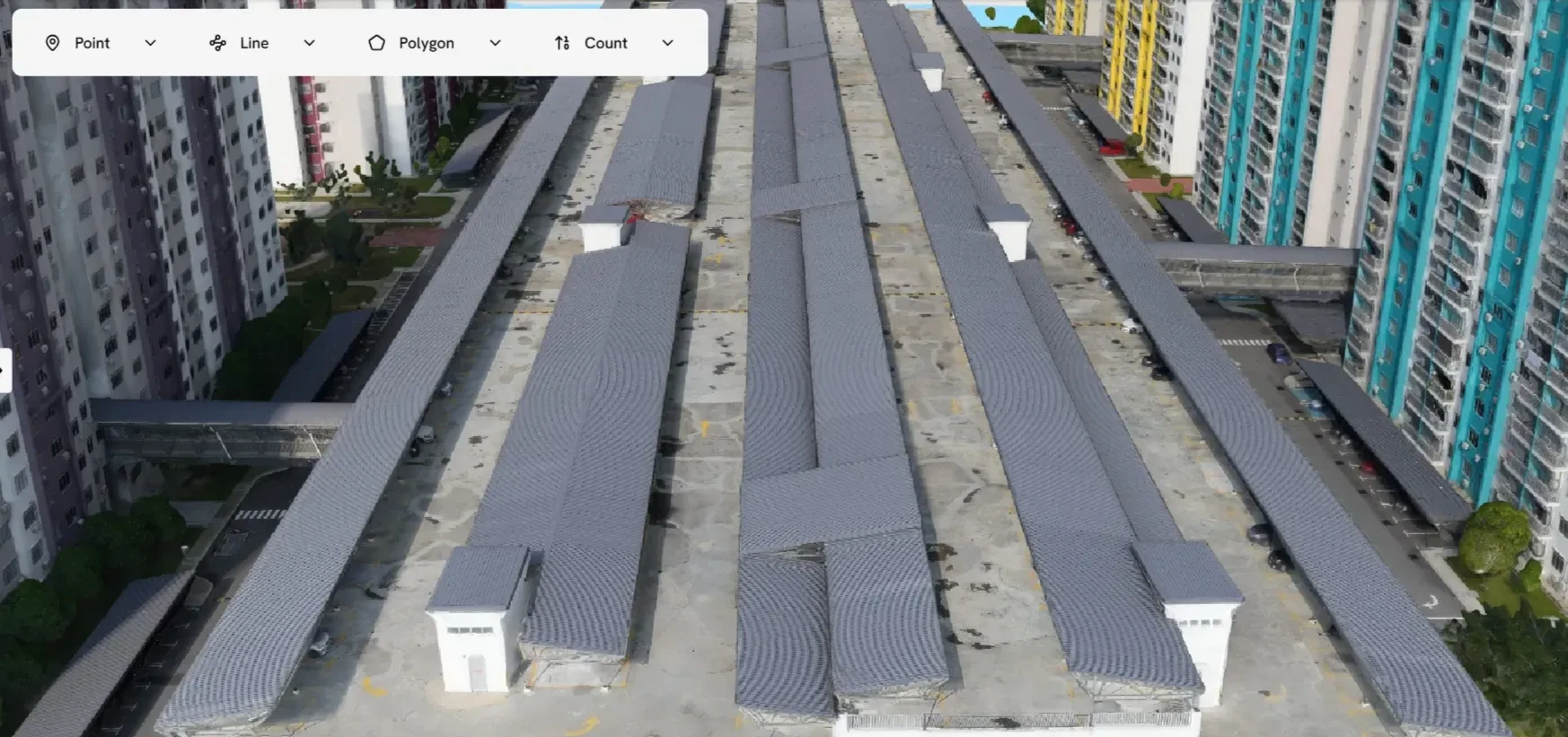
Aeroyantra delivers drone-based rooftop surveys and panel inspection that produce accurate 3D roof models and thermal inspection data without personnel access to the roof surface.
What Aeroyantra delivers for rooftop solar:
Pre-installation survey:
-
3D roof model - Precise photogrammetric 3D model of the roof surface for panel layout design, structural load point identification, and obstruction mapping
-
Roof area and slope measurement - Accurate roof area, slope angle, and aspect measurements for panel count estimation and layout optimization
-
Obstruction mapping - Georeferenced identification of vents, HVAC units, skylights, parapets, and other obstructions affecting panel placement
-
Structural element identification - Identification of roof structural elements for load point planning
-
Shadow analysis - Roof-level shadow analysis from parapets, plant rooms, and adjacent structures for layout optimization
Post-installation inspection:
-
Panel condition survey - High-resolution aerial imagery of installed panels for visual condition assessment without roof access
-
Thermal hotspot inspection - Panel-level thermal inspection identifying hotspots, bypass diode failures, and soiling anomalies across the rooftop array
-
Mounting and racking condition - Aerial inspection of mounting structures, ballast blocks, and racking systems for condition assessment
-
Roof membrane condition - Assessment of roof membrane condition around panel mounting penetrations and beneath array areas
Keep Your Solar Asset Performing at Design Output - Across Its Full 25-Year Life
A solar asset that performs at 95% of design output for 25 years generates significantly more revenue than one that degrades to 85% by year five because early-onset defects went undetected. Regular drone-based inspection is the most cost-effective tool available for maintaining generation performance across the operational lifecycle.
What Aeroyantra delivers for solar O&M inspection:
-
Annual or bi-annual thermal inspection - Full array thermal survey identifying all panel-level anomalies for prioritized maintenance planning
-
Vegetation management monitoring - Aerial identification of vegetation growth beneath and around arrays that creates shading and fire risk
-
Soiling assessment - Aerial identification of soiling patterns across the array for optimized cleaning scheduling
-
Mounting structure condition monitoring - Aerial inspection of mounting structure condition, corrosion, and mechanical integrity
-
Cable and conduit inspection - Aerial inspection of above-ground cable routing, conduit condition, and junction box accessibility
-
Post-storm damage assessment - Rapid aerial assessment of panel damage, structural damage, and debris accumulation after weather events
-
Generation performance correlation - Thermal inspection data correlated against SCADA generation data to identify panels and strings where thermal anomalies are causing measurable generation loss
Complete Deliverables by Project Phase
| Deliverable | Pre-Construction | Foundation | Construction | Commissioning | Operations |
|---|---|---|---|---|---|
| High-res orthomosaic | ✓ | ✓ | ✓ | ✓ | ✓ |
| Digital Terrain Model (DTM) | ✓ | - | - | - | - |
| LiDAR bare-earth terrain | ✓ | - | - | - | - |
| Slope and drainage analysis | ✓ | - | - | - | - |
| Pile position deviation map | - | ✓ | - | - | - |
| Row alignment verification | - | ✓ | - | - | - |
| Construction progress map | - | - | ✓ | - | - |
| Programme comparison | - | - | ✓ | - | - |
| Thermal hotspot report | - | - | - | ✓ | ✓ |
| Panel anomaly GPS report | - | - | - | ✓ | ✓ |
| Vegetation monitoring | - | - | - | - | ✓ |
| As-built documentation | - | - | - | ✓ | - |
| Time-series archive | - | - | ✓ | ✓ | ✓ |
Who Uses Aeroyantra for Solar Projects
Aeroyantra is used by solar EPC contractors, O&M service providers, developers, and asset managers managing:
- Utility-scale ground-mount solar projects
- Agricultural solar pump and feeder separation projects
- Commercial and industrial rooftop solar installations
- Solar park development and infrastructure projects
- IPP and developer-owned solar assets requiring regular O&M inspection
- Solar project lenders requiring independent construction progress verification
- Insurance assessors conducting post-event damage assessment on solar assets
- O&M contractors managing multi-site solar portfolios requiring consistent inspection data
Frequently Asked Questions
Q1: How does drone-based pile alignment verification work and what accuracy does it achieve?
After piling is completed in each array section, a drone survey captures high-resolution imagery and a photogrammetric 3D model of the pile cap positions. Pile cap centroids are extracted from the 3D model and compared against the design pile layout. Position deviations are calculated for each pile and displayed as a color-coded deviation map across the array. With RTK or PPK georeferencing, pile position accuracy of 2-3 cm is achievable - sufficient to identify piles that fall outside mounting structure tolerance before structures are erected. This workflow enables section-by-section sign-off, allowing mounting to begin in verified sections while piling continues elsewhere.
Q2: When should thermal inspection be conducted on a solar project?
Thermal inspection should be conducted at three key points: at commissioning before handover to the owner or O&M contractor, at the end of the first operational year to identify early-onset defects while warranty coverage is still active, and annually or bi-annually through the operational lifecycle for performance monitoring. Commissioning thermal inspection is the highest-value single inspection event - defects identified at this stage can be remediated under EPC warranty, whereas the same defects identified after warranty expiry become owner cost.
Q3: How many panels can Aeroyantra inspect in a single thermal survey flight?
Coverage per flight depends on drone type, flight altitude, thermal sensor resolution, and irradiance conditions. For standard utility-scale thermal inspection at panel-level resolution, a single drone covers 5-15 MW of installed capacity per day depending on site conditions. A 50 MW project is typically completed in 3-5 days of flying. For large solar parks of 100 MW or more, multi-drone deployments are available to compress the inspection timeline.
Q4: Can Aeroyantra data be integrated into PVsyst, Helioscope, or AutoCAD Civil 3D?
Yes. Aeroyantra exports terrain data in formats compatible with PVsyst and Helioscope for solar energy yield modeling, and in DXF, DWG, and LAS formats for AutoCAD Civil 3D for grading design and earthwork calculations. Orthomosaic and DTM data can be imported directly into most solar design platforms as base map and terrain layers.
Q5: Can drone surveys support solar project documentation requirements?
Yes. Aeroyantra produces georeferenced, time-stamped aerial records and progress reports suitable for project monitoring, construction verification, and lender independent engineer reporting. Progress documentation can be formatted to match specific project monitoring requirements. We recommend confirming format requirements with your project's independent engineer or monitoring agency before the first survey cycle.
Q6: How does Aeroyantra handle low-bandwidth conditions at remote solar project sites?
Aeroyantra is designed for field use in low-connectivity environments. Drone data is captured in the field and uploaded to the cloud processing platform when connectivity is available - either via site WiFi, mobile data, or physical transfer. Processed deliverables are accessible from the cloud platform once processing is complete, without requiring high-bandwidth connections in the field. Field teams can review preliminary results on-site using the mobile-compatible platform interface.
Q7: Can thermal inspection identify soiling patterns and recommend cleaning schedules?
Yes. Thermal imaging identifies non-uniform soiling patterns across the array - areas with higher soiling levels produce measurable thermal contrast relative to clean panels under identical irradiance conditions. Aeroyantra thermal inspection reports identify high-soiling zones across the array, enabling targeted cleaning rather than uniform washing of the full array. This reduces cleaning water consumption and labor cost while prioritizing the panels where cleaning delivers the highest generation recovery.
Q8: Can Aeroyantra support government solar program documentation?
Yes. Aeroyantra supports pre-construction site surveys, installation progress documentation, and commissioning inspection for government solar programs. For agricultural solar and rooftop solar projects, drone surveys provide the terrain and infrastructure mapping data required for project design and implementation documentation.
Ready to Catch Solar Project Problems at the Phase Where Fixing Them Is Still Affordable?
Whether you are surveying a greenfield site, verifying pile positions, tracking construction progress, or inspecting an operational array for hotspots and performance anomalies, Aeroyantra delivers the aerial data your solar project teams need across every phase of the project lifecycle.
Other Industries We Serve
Discover how Aeroyantra delivers survey-grade drone mapping across different sectors
Mining & Quarrying
Stockpile volumes, pit progression, and compliance documentation
Construction
Earthworks monitoring, cut/fill analysis, and as-built verification
Roads & Highways
Corridor mapping, alignment verification, and progress tracking
Rail & Linear Infrastructure
Corridor monitoring, embankment tracking, and ROW verification
Industrial & EPC
Site planning, structural inspection, and facility documentation
Waste Management
Landfill volume tracking, cell progression, and compliance
Smart City & Urban Works
Urban planning, land use monitoring, and GIS mapping
Agriculture
Precision farming, crop monitoring, and irrigation planning
Oil & Gas
Pipeline monitoring, facility inspection, and thermal imaging
Owners & Developers
Independent progress verification and quantity validation